
The Healthy Heart
The normal human heart is a remarkably efficient and powerful muscular pump that works continuously from before birth until the end of life. Beating about 70 times a minute at rest, it pumps nearly 7,000 litres of blood every day to supply oxygen and nutrients to all organs of the body. Roughly the size of a clenched fist, the heart is made entirely of specialized cardiac muscle, which has the unique ability to contract rhythmically and tirelessly without rest.
Structurally, the heart is divided into four chambers. The two upper chambers are called the atria, and the two lower chambers are known as the ventricles. The atria act as receiving chambers, collecting blood returning to the heart, while the ventricles serve as powerful pumping chambers that push blood either to the lungs or to the rest of the body. A thick muscular wall, known as the septum, separates the right and left sides of the heart, preventing the mixing of oxygen-rich and oxygen-poor blood.
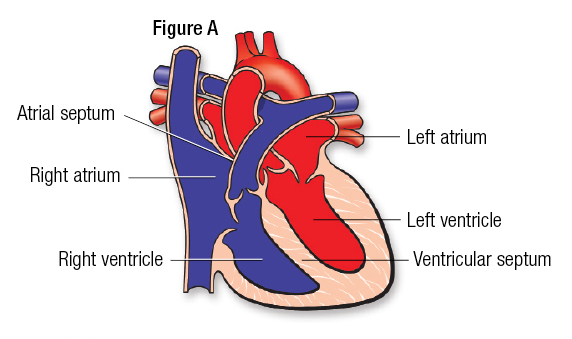
The orderly movement of blood through these chambers is controlled by four heart valves. These valves act like one-way doors, opening and closing in perfect coordination with each heartbeat to ensure that blood flows in only one direction. Any abnormality in this system can disrupt normal circulation. Congenital heart defects—conditions present from birth—may involve the valves, chambers, septum, major blood vessels, or the normal pathways of blood flow through the heart.
The four heart valves play distinct and essential roles:
The tricuspid valve, located between the right atrium and right ventricle, allows blood returning from the body to enter the right ventricle.
The pulmonary valve, situated between the right ventricle and the pulmonary artery, controls blood flow from the heart to the lungs for oxygenation.
On the left side of the heart, the mitral valve lies between the left atrium and left ventricle and regulates the flow of oxygen-rich blood coming from the lungs.
Finally, the aortic valve, positioned between the left ventricle and the aorta, governs the delivery of oxygenated blood to the entire body.
Each valve is composed of thin, flexible flaps known as leaflets or cusps, which open and close with every heartbeat. The mitral valve normally has two leaflets, while the tricuspid, pulmonary, and aortic valves each have three. These leaflets must open fully and close tightly; otherwise, blood may leak backward or face obstruction, placing extra strain on the heart.
Healthy heart blood flow patterns:
Blood flow through the heart follows a precise and continuous cycle. Blood depleted of oxygen returns from the body to the right atrium, passes into the right ventricle, and is pumped to the lungs through the pulmonary artery. In the lungs, carbon dioxide is removed and oxygen is absorbed. The oxygen-rich blood then returns to the left atrium, flows into the left ventricle, and is forcefully pumped through the aorta to supply the brain, muscles, and all vital organs. This uninterrupted circulation is essential for sustaining life and maintaining the body’s normal function.
From the body to the heart.
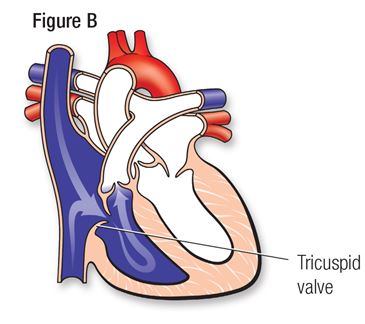
Figure B below shows dark bluish blood, low in oxygen, flowing back to the heart after circulating through the body. It returns to the heart through veins and enters the right atrium. This chamber empties blood through the tricuspid valve (B) into the right ventricle.
From the heart to the lungs
The right ventricle pumps the blood under low pressure through the pulmonary valve into the pulmonary artery. From there the blood goes to the lungs where it gets fresh oxygen (C).
From the lungs to the heart
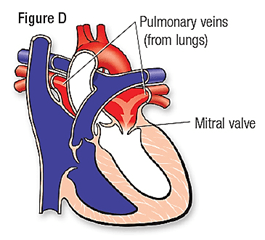
After the blood is refreshed with oxygen, it’s bright red. Then it returns to the left heart through the pulmonary veins to the left atrium. From there it passes through the mitral valve (D) and enters the left ventricle.
From the heart to the body
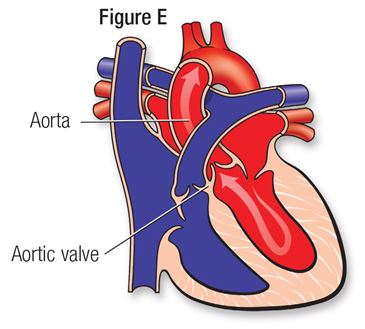
The left ventricle pumps the red oxygen-rich blood out through the aortic valve into the aorta (E). The aorta takes blood to the body’s general circulation. The blood pressure in the left ventricle is the same as the pressure measured in the arm.